Laser vs. Sclerotherapy
Vascular Laser vs. Sclerotherapy: Choosing the Right Treatment
David Green, M.D
In Short
Match the treatment to the problem. Sclerotherapy for most injectable surface veins on the legs. Surface laser for selected tiny vessels. Endovenous ablation for refluxing veins that show up on ultrasound. And before any of that, find out which problem you actually have. That one step saves more money, and more disappointment, than any device ever will.
Most people who search vascular laser vs. sclerotherapy are really asking two things. Will this make my legs look better? And should I be worried about these veins?
Those are different questions. The second one matters more. It's also the one people skip.
So here's the short version before the long one: the treatment follows the vein. Not whether you'd rather have a needle or a light. Not what your sister had done. The vein.
Figure Out What Kind of Vein You Have First
Spider veins are the thin red or purple lines sitting right under the skin. Fine reticular veins are a step bigger, usually blue-green, and often feed the spider veins around them. Varicose veins are the ropey, bulging ones you can feel with your fingers.
Vein size isn't trivia here. A vein generally counts as varicose at about 3 mm across, and most of the serious ablation research was done in people with primary symptomatic varicose veins >3 mm in diameter. Not cosmetic spider veins. Remember that the next time you see a study headline.
Then there's what's going on underneath. Reflux means the valves inside a vein have stopped closing properly, so blood slides backward and pools. That's usually where the aching, heaviness, cramping, itching, throbbing and end-of-day leg fatigue come from. Ankle swelling too.
Here's the part I'd want every patient to hear. You can't tell from the surface whether a patch of spider veins is only about cosmetic concerns or is the visible tip of a larger underlying vein that's failing. Treat only the surface veins in that second situation and they come back. Sometimes within months.
When You Need a Proper Vein Evaluation
If your veins hurt, swell, or the skin around them is changing color or texture, get a clinical evaluation before anyone treats anything. Not optional.
The standard test is a venous duplex examination: an ultrasound that shows the vein and uses Doppler ultrasound to show which way the blood is moving. It doesn't hurt, it takes a little while, and it's the thing that actually confirms reflux.
A good clinician will also go through your medical history. Pregnancy, medications, past blood clots or venous thrombosis, clotting disorders, previous vein treatments. That isn't paperwork for its own sake. Several of those answers change what's safe for you.
How Sclerotherapy Works
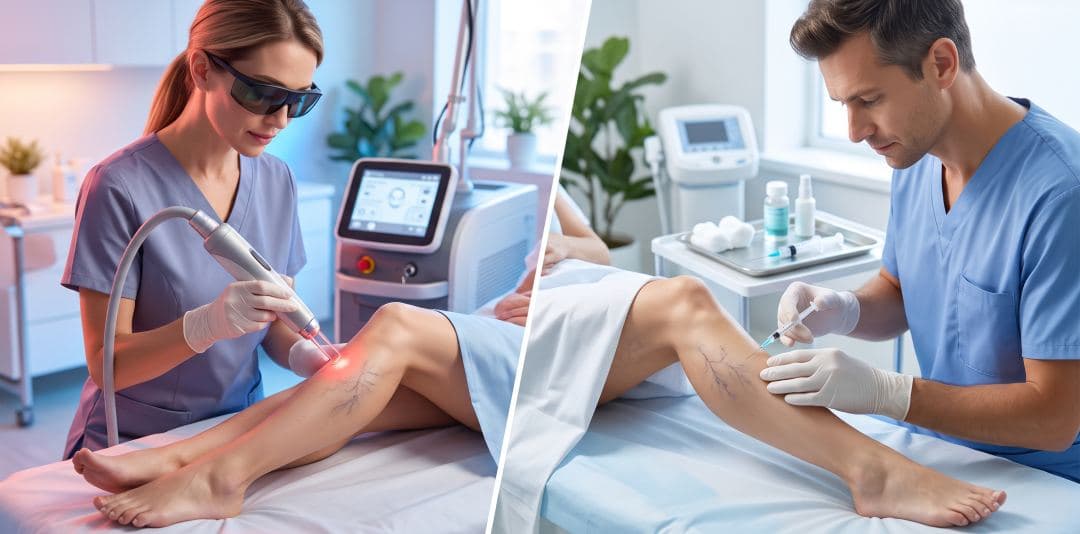
Sclerotherapy is a minimally invasive procedure, and an old, well-studied one. A clinician uses a fine needle to inject a sclerosant directly into the problem veins. The solution irritates the endothelial lining (the inner surface of the vein), the vein walls stick together, and over the next few weeks your body turns the closed vessel into fibrous tissue and reabsorbs it.
That scarring of the vein is the whole point. Vein occlusion first, fading after.
The sclerosant comes in two forms. Liquid sclerosants are the standard for spider veins. Foam sclerosants are the same drug whipped with air or gas into a microfoam, which pushes blood aside and stays against the vein wall longer. Foam sclerotherapy is what gets used on bigger tributaries, usually with ultrasound guidance.
Sodium tetradecyl sulfate is one of the most common agents. Concentration gets matched to the vessel: low for spider veins, and up to 3% sodium tetradecyl sulfate for larger blood vessels.
It's an in-office procedure. A session typically runs 30-45 minutes, depending on how many veins are being treated.
Who Sclerotherapy Suits
The classic case is accessible spider veins and fine reticular veins on the legs. Foam can also handle selected larger tributary veins, once someone has checked for reflux.
A few things make it less simple. A history of venous thrombosis, certain clotting risks, and pregnancy all need a real conversation first. If you have darker skin types, talk through pigmentation risk too, because the brownish staining after sclerotherapy can hang around.
And if needles genuinely frighten you? That counts. It's one of the few places where personal preferences really should tip the decision.
Results, Recovery, and the Annoying Bits
Don't expect clean legs next week. Results develop gradually over several weeks to months, and multiple sessions may be necessary.
Short term you might get bruising, soreness, stinging where the injection went in, redness, and skin color changes along the treated vein. Telangiectatic matting is the one nobody warns you about: a faint blush of brand-new tiny vessels around the treated spot. It often settles by itself. Sometimes it needs its own treatment.
Aftercare is simple, but people still skip it. Walking soon after treatment keeps blood moving. Compression stockings are usually prescribed for a stretch, and you'll be told to avoid intense exercise for a little while.
How Vascular Laser Treatment Works
A laser device sends laser light energy into the skin or into the vein. Hemoglobin in the blood absorbs that light and converts it to heat. The heat causes tissue coagulation, and the vessel closes.
Same basic idea every time. But "laser treatment" covers two completely different procedures, and mixing them up is probably the most common confusion in this whole topic.
Surface Laser Treatment
Surface laser treatment works from the outside, through the skin. It's a non-invasive procedure: no needle, no incision. It's mainly for very small superficial vessels, facial veins, and spots a needle can't easily reach.
It isn't painless, though. Most people describe a hot snap, like a rubber band. Cooling and surface anesthesia take the edge off the physical discomfort. Everyone in the room wears protective eyeglasses, because ocular damage from medical lasers is a real risk and not a formality.
Possible side effects: redness, swelling, blistering, pigment changes including hypopigmentation, and occasionally burns or small sores. Skin type drives the device choice and the settings. Get that wrong and you trade a red line for a pale patch.
You'll see surface laser marketed as a "chemical-free alternative" to injections. Technically true. Also not a reason to pick it. A heat injury is still an injury.
Endovenous Laser Ablation (EVLT)
Endovenous laser therapy (EVLT), also called endovenous laser ablation, works from the inside. Under ultrasound guidance the clinician slides a small catheter into a diseased truncal vein, like the great saphenous vein or the small saphenous vein, and passes a small laser fiber through it. Local anesthesia goes in along the vein, the fiber is pulled back as it fires, and the heat seals the vein shut.
This is what treats reflux at the source. It doesn't treat spider veins, and it's not supposed to.
It's one of several outpatient procedures for that job. Radiofrequency ablation is the other common thermal ablation option. There are also nonthermal ablation methods, like medical adhesive or mechanochemical techniques, that skip the heat and most of the numbing injections. Laser ablation usually takes 30-60 minutes, and most people walk out on their own.
A diode laser (980 nm) was one of the early workhorse wavelengths for this. Longer wavelengths and newer fiber tips are common now.
The follow-up scan matters. Clinicians watch for ablation-related thrombus extension, where clot from the treated vein creeps toward the deep veins. You'll see it called endovenous heat induced thrombosis (EHIT) after laser or radiofrequency, endovenous foam-induced thrombosis (EFIT) after foam, and postablation superficial thrombus extension when it stays in the surface system. Catching it early is the point of that appointment.
Vascular Laser vs. Sclerotherapy: How They Really Compare
Neither one is better. I know that's an unsatisfying answer. It's still true, and anyone who tells you otherwise without scanning your legs is selling something. Vein size, depth, location, color, skin type, symptoms and reflux decide it.
That said, for leg spider and reticular veins, sclerotherapy has an excellent track record. The 2023 multisociety clinical guidelines recommend it for symptomatic leg spider and reticular veins, with surface laser useful in selected cases. On legs, sclerotherapy often requires fewer sessions than surface laser, it can treat a lot of injectable veins in one visit, and many vein specialists find it gives superior cosmetic results there. Laser earns its place with tiny vessels a needle can't hit, and with needle-phobic patients.
Larger refluxing veins are a different fight. The CLASS trial, a large randomized study across 11 UK centers, compared laser ablation, foam sclerotherapy and surgery in people with primary varicose veins. At five years, laser ablation and surgery both produced greater improvement in disease-specific quality of life than foam. On cost modelling, laser came out with roughly a 77% probability of being cost-effective. Again: truncal varicose veins. Not spider veins.
What the Head-to-Head Laser Studies Actually Looked At
Here's something that surprised me. A lot of the direct laser group vs. sclerotherapy group comparisons you'll find online come from vascular malformations in the mouth and face, not from legs.
Vascular malformations are abnormal clusters of vessels, usually present from birth. A low-flow vascular malformation (mostly venous) is often treated with sclerotherapy or laser. High-flow vascular malformations, where arteries feed straight into veins, are a different problem entirely and usually need imaging such as a CT angiogram plus specialist care.
In one 2022 study of 40 people with oral vascular malformations, half got 3% sodium tetradecyl sulfate and half got a diode laser (980 nm) using transmucosal thermophotocoagulation. The laser group had mild to moderate pain, against severe pain in the sclerotherapy group, and fewer side effects overall. But recurrence was observed more in the laser group. Both treatments worked. A related study on oral pyogenic granulomas, using an Indilase 980 nm diode, saw the same pattern: laser was gentler, sclerotherapy held up better.
That tradeoff, comfort with laser and durability with sclerotherapy, shows up again and again.
The oral protocols are detailed. A diascopy test comes first: pressing a glass slide on the lesion to see if it blanches, which confirms it's vascular. Sclerotherapy is an intralesional injection, often after perilesional infiltration of local anesthetic such as 2% lignocaine without epinephrine. Laser protocols lean on a cold physiological solution to cool the tissue, forced dehydration of the lesion, a dry operating field, and a compartmentalization and serial steps technique that treats the lesion section by section. Outcomes get graded as a complete response or a moderate response. Intraoral edema and prolonged healing time are the usual complaints.
Interesting work. How much does it tell you about your legs? Not a lot. Different tissue, different vessels, different equipment.
Sessions and Results
Improvement is slow with every option, spread across a healing period of weeks to months. Nobody honest promises complete clearance. Recurrences happen with both, and new veins may develop over time, because whatever made you prone to the first ones hasn't gone anywhere.
For a lot of people the smart plan is a combination approach. Close the leaking vein first with ablation, then clean up the surface veins that are left with sclerotherapy or laser. Doing it the other way round mostly wastes money.
Comfort, Downtime, and Cost
Sclerotherapy stings for a second. Surface laser snaps for a second. Endovenous work happens under local anesthesia, and afterward people often notice tightness along the thigh, some bruising, a pulling feeling, or temporary changes in skin feeling. Most of that fades in a week or two.
Surface treatments mean minimal downtime. Endovenous treatment has more aftercare, but most people are back at work quickly.
On cost, sclerotherapy is often more economical than laser treatment for cosmetic spider veins. Part of that is the high cost of the procedure on the laser side (equipment, per-session pricing), and part is that laser may need more visits. For refluxing varicose veins the math can flip, which is what the CLASS numbers suggest. Cost-effectiveness and cheapest aren't the same thing.
Insurance coverage depends on your plan and on medical necessity. Treatment for documented, symptomatic reflux is often covered. Cosmetic spider vein work almost never is.
Risks Worth Knowing About
The common stuff is short-lived: redness, bruising, tenderness, swelling, temporary skin color changes.
Less common: adverse reactions to sclerosing agents, ulceration, superficial vein thrombosis, deep vein thrombosis, and skin injury. With sclerotherapy specifically, allergic reactions to the injection solution can happen, though they're uncommon.
Blood clots are the one to take seriously. A deep clot can break off and reach the lungs as a pulmonary embolism. Chest pain, shortness of breath, sudden heavy swelling in one leg, or pain that keeps getting worse: get seen urgently. Don't wait for your follow-up.
Mistakes People Make
The big one is assuming bulging, aching veins are just a looks problem. Often they aren't.
Second, assuming all lasers, all sclerosants and all providers are interchangeable. They're not. Who's holding the needle or the fiber changes outcomes more than any brand name.
Third, skipping the boring parts. Wear the compression. Keep the ultrasound follow-up. And when you weigh the options, count better symptom relief and how your legs feel at 4 p.m. on a workday, not just the price.
Choosing Who Treats You
Look for a board certified vascular surgeon, or another qualified physician with additional training in vein treatment and vein ultrasound.
Then ask them straight out. Which veins are actually the problem, and is there reflux? Do I need a duplex scan first? How many treatment sessions should I expect? Who deals with it if something goes wrong? What will I pay out of pocket? And what exactly do I do in the week afterward?
A clinician worth seeing will tell you whether the goal is cosmetic improvement, fixing reflux, or both. If they can't answer that clearly, keep looking.
Frequently Asked Questions
Is vascular laser better than sclerotherapy for spider veins?
Usually not on the legs. Sclerotherapy is the go-to for accessible leg spider veins and reticular veins. Surface laser makes more sense for very tiny vessels, facial veins, veins that are hard to inject, or people who really can't handle needles.
Which treatment is more painful, laser or sclerotherapy?
Sclerotherapy means quick needle sticks and a bit of stinging. Surface laser feels hot, like a snap against the skin. Pain varies with the area, how much is being treated, and whether cooling or numbing is used. In the oral malformation research the laser group reported less pain, but that's mouths, not legs.
How many sessions does spider vein treatment take?
More than one, most of the time. It depends on how many veins you have, how big they are, where they are, how you respond, and whether reflux underneath needs fixing first.
Can laser treatment remove varicose veins?
Endovenous laser ablation can close larger refluxing veins under ultrasound guidance, and it does that well. Surface lasers aimed through the skin aren't the main answer for big, bulging varicose veins.
Does insurance cover sclerotherapy or laser vein treatment?
It depends on your plan and on medical necessity. Insurers usually want documented symptoms and ultrasound findings. Cosmetic spider vein treatment is almost always self-pay.

Dr. David Green, M.D.
Board-Certified Dermatologist · LaserDerm & Vein Centers, Bethesda, MD
More about Dr. Green ›Published October 22, 2026 · Updated October 22, 2026
Ready to schedule a consultation?
Dr. Green and our team are here to help. Call 301-907-7250 or request an appointment online.
Request an Appointment