Vein Care
The Complete Guide to Spider and Varicose Vein Treatments in Bethesda
Written by Dr. David Green, M.D., Board-Certified Dermatologist
In Short
If your veins only bother you when you look at them, treatment is cosmetic — sclerotherapy for spider veins, a vascular laser for capillaries. If your legs ache, swell, cramp or feel heavy by day’s end, that is medical vein disease: a duplex ultrasound finds the failing saphenous vein, endovenous ablation or VenaSeal closes it, and insurance usually covers it. Get the ultrasound first — everything else follows from it.
Key Takeaways
- Size decides the treatment. Spider veins are under 2 millimeters and respond to sclerotherapy. Varicose veins are over 2 millimeters and usually need endovenous ablation first. Dilated capillaries are under 0.2 millimeters and are a laser job.
- Visible veins are often the symptom, not the problem. The failing vein is usually the saphenous vein, which sits deep enough that you cannot see it. It only shows up on duplex ultrasound.
- Symptoms change the insurance math. Cosmetic spider veins are almost never covered. Symptomatic varicose veins caused by chronic venous insufficiency usually are, including under Medicare.
- Almost all of it is outpatient now. Minimally invasive treatments use local anesthesia, take under an hour, and most patients walk out and resume normal activity the same day.
- Bethesda has two distinct vein corridors: the Rockledge Drive cluster in North Bethesda near I-270 and I-495, and the downtown Bethesda offices near the Metro. Who you see matters more than where.
Start here: is this cosmetic or is it medical?
Answer first: if the veins only bother you when you look at them, it is cosmetic. If your legs ache, swell, cramp, itch, or feel heavy by the end of the day, it is medical, and it has a name.
That distinction drives everything else in this guide. It determines which procedure you get, whether a vein clinic bills your insurance, and honestly, whether treating the veins you can see will accomplish anything at all.
Plenty of people in Bethesda spend money treating surface veins that come right back within a year. Usually that is because nobody checked what was feeding them.
Spider veins, varicose veins, and dilated capillaries are three different things
Answer first: they are classified by width, and the width tells a vein doctor which tool to reach for.
Varicose veins
Enlarged, non-functional veins wider than 2 millimeters. Some exceed 2 centimeters. They look blue or green, and the bad ones protrude as twisting cords under the skin.
Here is a useful test. Varicose veins are most obvious when you are standing, because their valves cannot stop blood from pooling with gravity. Lie down or elevate the leg and they often shrink or vanish. That is not the vein healing. That is gravity taking a break.
Spider veins
Enlarged veins under 2 millimeters. Deep red, blue, or purple, usually flat, sometimes raised when you stand. Sclerotherapy is the most effective way to clear them, and it is not close.
Dilated capillaries
Also called broken capillaries or broken blood vessels. Thread-like red or pink lines under 0.2 millimeters. Cluster enough of them together and you get what looks like a red patch or a bruise that never fades. They turn up on the legs, but also on the cheeks and nose.
These need a vascular laser. A needle is too big for the target.
The symptoms that mean your veins are more than a cosmetic annoyance
Answer first: aching, swelling, cramping, itching, heaviness, and skin changes around the ankle.
Watch for these:
- Leg pain that builds through the day and eases when you put your feet up
- Leg heaviness or fatigue, often described as legs feeling like they are full of sand by 4pm
- Leg swelling, usually worst at the ankle
- Leg cramps, particularly at night
- Itching over the vein or across the lower shin
- Restlessness in the legs at night
- Skin discoloration or texture change around the ankle
- Venous ulcers, which are open sores that will not close
A note on restless leg syndrome
It gets oversold in vein marketing. Restless leg syndrome is a neurological disorder with its own diagnostic criteria. It is not caused by varicose veins. What is true is that venous insufficiency can produce a restless, crawling discomfort at night that feels a lot like it, and some patients carry both conditions at once. If your legs will not settle at night, get the veins looked at. Just do not expect a vein procedure to be a guaranteed fix for diagnosed RLS.
Venous ulcers are the one item on that list that should move you from “I’ll deal with it eventually” to “I’m calling this week.” Ulcers mean the pressure problem has been running long enough to damage tissue.
Chronic venous insufficiency: the thing underneath the visible veins
Answer first: chronic venous insufficiency is when leg veins stop moving blood back toward the heart properly, and the visible veins are downstream evidence of it.
Healthy veins have one-way valves that push blood upward against gravity. When those valves fail, blood falls back and pools. Pressure builds. The vein walls stretch. And the veins you can see are what that pressure looks like from the outside.
Venous insufficiency runs on a spectrum. At the mild end it is purely cosmetic, some spider veins and nothing more. At the severe end you get swelling, skin discoloration, and ulceration.
The scale is not small. According to NIH clinical reference material on venous insufficiency, roughly 150,000 new patients are diagnosed with CVI each year in the United States, with close to $500 million spent on their care. Left alone, CVI tends to progress toward venous ulcers rather than stabilize.
Risk factors are mostly things you did not choose. Heredity is the big one, and it comes down either side of the family. Add pregnancy, standing occupations, obesity, prior leg injury, and previous thrombophlebitis. Roughly 40% of women have varicose veins or spider veins. Men get them too, just less often.
Related reading on this site: chronic venous insufficiency and how it is diagnosed.
What about blood clots and deep vein thrombosis?
Answer first: varicose veins and deep vein thrombosis are different conditions in different vein systems, but having one raises your odds of the other, and DVT is the emergency.
Varicose veins live in the superficial system, close to the skin. Deep vein thrombosis happens in the deep veins, and the danger is that a clot breaks loose and travels to the lungs.
Call a doctor the same day if one leg develops sudden swelling, pain or tenderness in the calf, warmth, or skin discoloration. Roughly half of DVT cases produce no symptoms at all, which is exactly what makes them dangerous. MedlinePlus, from the NIH, covers the warning signs in plain language.
A history of blood clots also changes your treatment options. Tell any vein specialist about it before you start, not after.
Diagnosis: if nobody scans your legs, leave
Answer first: a proper vein workup means a duplex ultrasound, not a visual once-over.
The saphenous veins are the usual culprits behind varicose veins, and they are typically not visible. They are only imaged by duplex ultrasound. Most of the bulging veins you can see are branches or tributaries of them.
This is the part patients skip and regret. You can inject every visible vein on a leg, and if the saphenous vein above them is still failing, pressure keeps feeding new ones. That is the mechanism behind “my veins came back.”
Ultrasound guidance also matters during treatment, not just before it. Endovenous ablation is performed with the catheter positioned under duplex ultrasound so the right segment gets treated.
So when you call a vein treatment clinic, ask one question: does the consultation include a duplex ultrasound, and who reads it?
The treatment options, matched to what you actually have
Sclerotherapy
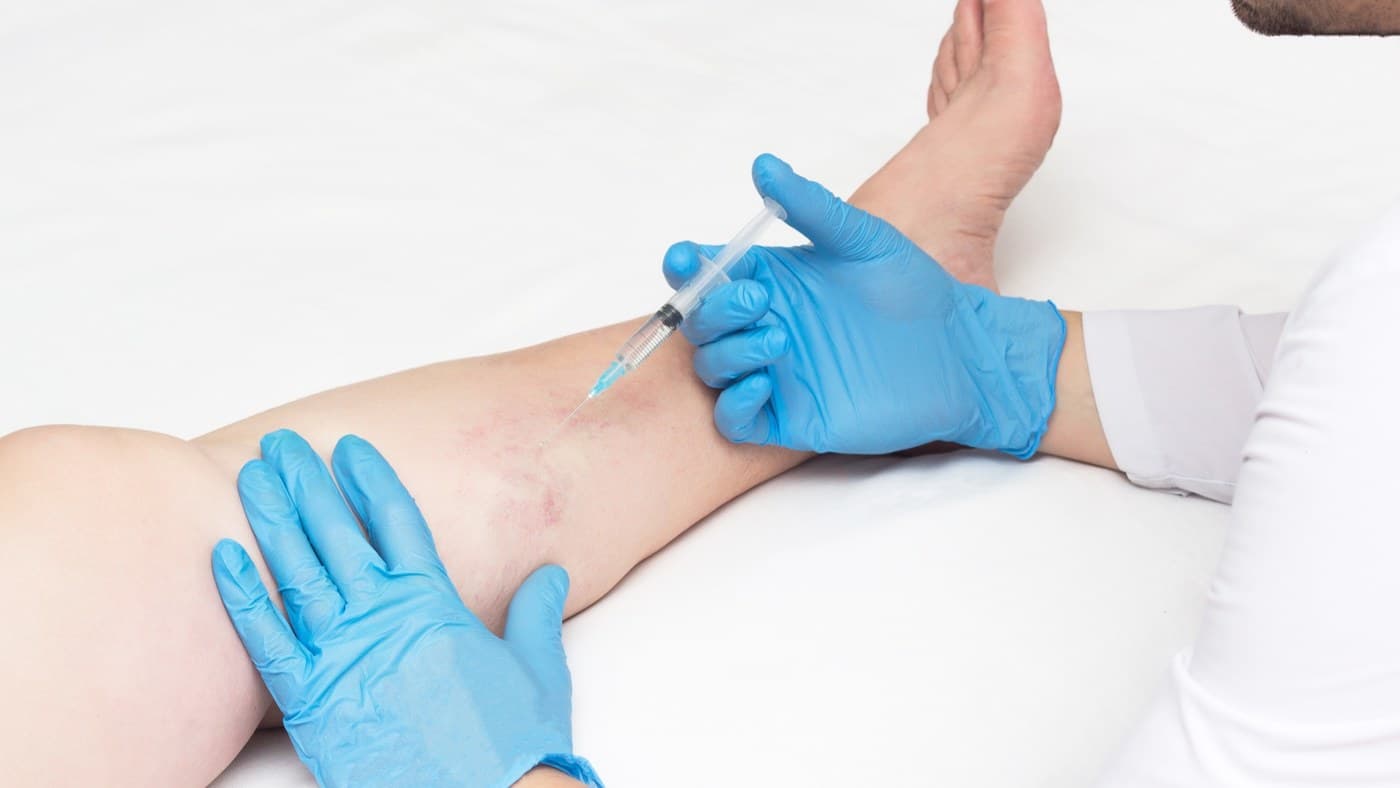
The most consistently effective non-surgical way to clear unwanted spider veins and varicose veins. A very small needle delivers a sterile solution called a sclerosant into the vein. The solution damages the vein wall permanently, and over the following weeks to months the body absorbs the vein.
It works on legs and thighs mostly, but facial veins and prominent veins on the hands and feet can be treated the same way. Sessions run short. Larger varicose veins can be treated with ultrasound-guided sclerotherapy.
If you have thought about injectable treatments before, the mechanics will feel familiar. The needle work is comparable to what happens in cosmetic injectable procedures, though the goal and the solution are entirely different. Learn more: how sclerotherapy is performed.
Endovenous ablation
For the saphenous veins, which are usually too large for sclerotherapy to handle. A narrow catheter goes inside the failing vein under duplex ultrasound guidance. Thermal energy heats and seals the vein closed, and the body absorbs it over the following weeks.
Two versions exist. Radiofrequency ablation uses radiofrequency energy. Endovenous laser ablation uses laser energy. Both heat the vein from the inside, and outcomes between them are broadly comparable. The National Heart, Lung, and Blood Institute describes both as office-based procedures performed with ultrasound and local numbing.
Recovery is easier than people expect. Almost all activities can be resumed immediately. You will wear a compression stocking on that leg for at least two weeks. Expect some swelling, bruising, and tenderness along the vein for a few days or weeks. Numbness along the vein happens sometimes and can take months to fade.
One expectation to set now: endovenous ablation usually does not erase your visible varicose veins. It treats the saphenous vein feeding them. The visible branches often look less prominent afterward, and whatever remains gets cleaned up with sclerotherapy. Ablation first, sclerotherapy second. That sequence is the whole game. Learn more: what endovenous ablation involves.
VenaSeal
A medical adhesive closes the diseased vein instead of heat. A small catheter delivers the adhesive under ultrasound guidance, and blood reroutes to healthy veins nearby.
The appeal is what it skips. No heat, no repeated needle sticks along the vein, and no tumescent anesthesia running the length of the leg. For patients who dread the numbing more than the procedure, that is a real difference. Learn more: the VenaSeal procedure.
Laser vein treatment for capillaries
Laser light passes through the skin and is absorbed preferentially by the blood vessel. The absorbed light converts to heat, the capillary wall is altered permanently, and the vessel clears.
Wavelength choice depends on the lesion. A 532nm KTP or a 1064nm Nd:YAG covers most vascular targets, including cherry hemangiomas, spider angiomas, venous lakes, rosacea redness, and port wine stains.
Most people describe each pulse as a rubber band snap. Redness and mild swelling settle within hours to a few days, and there are no activity restrictions afterward. Bright red lesions clear faster than faint ones. Cherry hemangiomas and spider angiomas usually go in a single session.
Laser and light treatments are the right call for capillaries and the wrong call for large varicose veins. Anyone offering to laser a bulging cord on your calf from the skin surface is selling you the wrong procedure. Learn more: laser treatment of dilated capillaries and vascular lesions.
Ambulatory phlebectomy
Also called microphlebectomy or simply phlebectomy. Bulging surface varicose veins are removed through tiny punctures under local anesthesia. It is typically paired with ablation rather than used alone, and it suits ropy veins that sit too shallow for good sclerotherapy results. Not every practice offers it, so ask directly.
Compression therapy
Compression stockings do not remove veins. They manage symptoms and slow progression, and they are frequently required after procedures. Many insurers also want documented compression therapy before they will approve anything else.
Get fitted properly. The American Academy of Dermatology recommends having a board-certified dermatologist confirm size and pressure rather than guessing from a pharmacy shelf. Wrong compression is uncomfortable enough that people quit wearing it, which defeats the point.
Treatment comparison
| Vein type | Width | Primary treatment | Anesthesia | Downtime | Typically covered? |
|---|---|---|---|---|---|
| Dilated capillaries | Under 0.2 mm | Vascular laser (532nm / 1064nm) | None | None | No, cosmetic |
| Spider veins | Under 2 mm | Sclerotherapy | None | Minimal | Rarely, usually cosmetic |
| Varicose veins (branches) | Over 2 mm | Sclerotherapy, sometimes phlebectomy | Local if phlebectomy | Same day recovery | Often, if symptomatic |
| Saphenous vein reflux | Not visible | Radiofrequency ablation, endovenous laser ablation, or VenaSeal | Local | Same day recovery, 2 weeks compression | Usually, if documented |
The effects and benefits: what actually changes
Answer first: symptom relief tends to arrive faster than the cosmetic result, and the cosmetic result keeps improving for months.
- Symptoms ease first: Aching, heaviness, cramping, and swelling often improve within weeks of closing off the failing vein, because you have removed the pressure source. Patients frequently report they can stand through a workday again.
- Appearance catches up slowly: Treated veins are absorbed over weeks to months, not days. Sclerotherapy in particular looks worse before it looks better, with bruising and darkening along the treated vein. Judge results at three months, not three weeks.
- Progression slows: This is the benefit nobody markets because it is invisible. Untreated CVI generally gets worse. Treating reflux early reduces the risk of ending up with skin damage and venous ulcers later.
- Ulcer risk drops: For patients already showing skin changes at the ankle, correcting the underlying reflux is what gives an ulcer a chance to heal and stay healed.
- Sleep and activity improve: Night cramps and leg restlessness often settle once venous pressure comes down.
- You get an answer: Even when the scan shows nothing wrong, that is worth knowing. It rules out CVI and tells you the veins really are just cosmetic.
Safety, risks, and what can go wrong
Answer first: these are low-risk office procedures, but they are still procedures, and complications exist.
Bruising, pain, and skin color changes are common after ablation and usually temporary. Serious complications are rare and include numbness, skin burns, and venous thromboembolism. Foam sclerotherapy carries a small risk of skin color changes and, rarely, clotting complications.
Three things genuinely raise your risk profile:
- A history of blood clots or a clotting disorder: This can rule out certain treatments entirely. Disclose it up front.
- Pregnancy: Most vein treatment is deferred. Veins that appear during pregnancy also sometimes improve on their own afterward.
- Treating the wrong vein: Not a complication in the textbook sense, but it is the most common way patients end up disappointed and out of pocket.
Independent reading before your consultation
RadiologyInfo, from the Radiological Society of North America, publishes a plain-language breakdown of sclerotherapy risks worth reading before your consultation.
Insurance coverage in Maryland, and what "free insurance verification" really means
Answer first: symptomatic varicose veins caused by documented saphenous insufficiency are usually covered. Spider veins almost never are.
When demonstrable, symptomatic saphenous vein insufficiency is present, most health insurance carriers including Medicare consider treatment medically necessary and cover it. Cosmetic spider vein treatment sits outside that. The AAD says the same thing: varicose vein treatment can be covered when there is an underlying issue to fix, while spider vein treatment is generally considered cosmetic.
What usually has to happen first:
- Documented symptoms, not just visible veins
- A duplex ultrasound demonstrating reflux
- A trial period of conservative treatment, typically compression stockings for several weeks
- HMO plans generally require a referral from your primary care doctor before you see a specialist
About "free insurance verification"
Several vein clinic chains advertise it, and it is a legitimate convenience. But understand what it is. It is a staff member calling to confirm your plan is accepted and checking your benefits. It is not preauthorization, it is not a coverage guarantee, and it does not tell you whether your specific procedure will be approved. Ask for that in writing before scheduling anything expensive.
Related: insurance participation details.
The Bethesda vein care map
Answer first: vein care in Bethesda clusters in two places, and the practices in them come from different medical specialties.
The Rockledge Drive corridor, North Bethesda. Off Old Georgetown Road and easy to reach from both I-270 and I-495, this is where most of the area’s dedicated vein specialists sit. Capitol Vein & Laser Centers is at 6410 Rockledge Drive, led by Dr. Paul McNeill and Dr. Garth Rosenberg, board-certified in peripheral vascular surgery. A few buildings down, 6903 Rockledge Dr Suite 480, Bethesda, MD 20817, in the CAPROCK building, houses several vein treatment clinic operations, with physicians including Dr. Kamran Saraf listed at that address. That building sits near Westfield Montgomery Mall and Cabin John Regional Park.
Center for Vein Restoration runs three Montgomery County clinics, including North Bethesda/Rockville and Silver Spring. Their Maryland vein clinics are staffed by physicians such as Dr. Eddie Fernandez, who completed a phlebology fellowship and serves as an Associate Professor of Emergency Medicine at Georgetown University School of Medicine.
Downtown Bethesda. A shorter list, closer to the Metro, generally dermatology-led practices offering vein care alongside skin and laser treatment.
The naming gets confusing fast. “Maryland Vein Centers” and “Maryland Vein Clinics” appear as branding across several unrelated organizations and multiple websites. Do not assume two similar names mean two different practices, or that they mean the same one. Look at the physician, not the sign.
Which specialty should you see? It depends on your vein size, which brings us back to the top of this guide.
- Vascular surgeons: handle the deep and complex cases, and surgical options if it comes to that.
- Phlebologists: specialize specifically in vein disorders.
- Interventional radiologists: bring imaging-guided technique to ablation.
- Dermatologists: treat leg veins routinely, especially where skin changes, capillaries, and cosmetic outcome matter. The AAD notes that sclerotherapy has been refined within dermatology for decades.
Why some Bethesda patients choose a dermatologist for vein care
Answer first: because skin and veins are the same problem at the surface, and one physician handling both avoids a referral loop.
LaserDerm & Vein Centers of Maryland, the practice of David Green, MD, sits in downtown Bethesda at 4800 Montgomery Lane, Suite L50, one block west of Wisconsin Avenue and a short walk from the Bethesda Metro station. Dr. Green is board-certified by the American Board of Dermatology, a Fellow of the American Academy of Dermatology, a member of the American Society for Dermatologic Surgery, and a member of the American Vein & Lymphatic Society. He spent many years as a Clinical Associate Professor of Dermatology at Howard University Hospital in Washington, D.C.
Practically, what that combination means:
- The full range under one roof: Sclerotherapy, endovenous ablation, VenaSeal, and vascular laser, so the treatment gets matched to vein size instead of to whatever the practice happens to own.
- Capillaries and skin changes taken seriously: Venous disease shows up in the skin first. Discoloration, texture change, and dilated capillaries are dermatologic problems as much as vascular ones.
- Cosmetic judgment: Dermatologic surgery is built around how skin looks afterward.
Further reading on this practice’s approach
For a sense of how this practice approaches procedural safety and technique generally, the discussion in the science and safety behind injectable treatments covers the same underlying philosophy applied to a different procedure.
Bottom line
Get the ultrasound. Everything else follows from it.
If the scan is clean, your veins are cosmetic and sclerotherapy or laser will handle them without much fuss. If it shows saphenous reflux, you have vein disease, treatment order matters, and there is a real chance your insurance covers it.
The mistake worth avoiding is treating what you can see while ignoring what you cannot. It costs money, and the veins come back.
And in the meantime, walk. Venous return depends on the calf muscle pump, so walking the trails at Cabin John Regional Park does more for your legs than any supplement marketed for vein health.
Explore further: varicose veins, spider veins, and dilated capillaries — or request a consultation.
Frequently Asked Questions
How long does spider vein treatment take, and how many sessions will I need?
A sclerotherapy session is short, often 15 to 20 minutes, and several veins can be treated at once. Most people need more than one session. The treated veins are absorbed gradually over weeks to months, so the final result is not visible immediately.
Will my varicose veins come back after treatment?
A properly closed vein does not reopen. What can happen is new veins forming, usually because the underlying reflux was never corrected. That is why the saphenous veins get scanned and treated before the visible branches. Heredity does not go away, so ongoing monitoring is reasonable.
Is vein treatment painful, and what is recovery like?
Most procedures use local anesthesia or none at all. Sclerotherapy involves a very small needle. Laser pulses feel like a rubber band snap. Endovenous ablation allows almost all activities to resume immediately, with a compression stocking worn for at least two weeks. Same day recovery is the norm rather than the exception.
Does insurance cover varicose vein treatment in Maryland?
Usually yes, when a duplex ultrasound documents saphenous vein insufficiency and you have symptoms such as leg pain, leg swelling, or venous ulcers. Most carriers including Medicare treat that as medically necessary. Purely cosmetic spider vein treatment is generally not covered. HMO plans typically require a referral first.
Sources & further reading
- 1.Venous Insufficiency — StatPearls, National Library of Medicine (NIH)
- 2.Deep Vein Thrombosis — MedlinePlus, National Library of Medicine (NIH)
- 3.Varicose Veins — National Heart, Lung, and Blood Institute (NIH)
- 4.Leg veins: Why they appear and how dermatologists treat them — American Academy of Dermatology
- 5.Sclerotherapy of Varicose Veins — RadiologyInfo, Radiological Society of North America

Dr. David Green, M.D.
Board-Certified Dermatologist · LaserDerm & Vein Centers, Bethesda, MD
More about Dr. Green ›Transparency note: this guide is published by LaserDerm & Vein Centers of Maryland, the downtown Bethesda practice of Dr. David Green, M.D., which is discussed above. Descriptions of other practices are drawn from their own published materials and public listings, and are scheduled for re-verification every six months. This guide is for general information and is not a substitute for a medical evaluation — vein disease is diagnosed with a duplex ultrasound performed by a qualified clinician.
Published September 8, 2026 · Updated September 8, 2026
Ready to schedule a consultation?
Dr. Green and our team are here to help. Call 301-907-7250 or request an appointment online.
Request an Appointment